

QUICK ANSWER
- Recovery after double eyelid surgery is a gradual, staged process rather than a single fixed event, involving early tissue healing, functional recovery and longer-term tissue settling that occur at different speeds.
- In the first few days the upper eyelids are typically swollen, bruised and may look uneven or higher than expected; over the first 1 to 2 weeks swelling and bruising gradually reduce and some daily activities may resume, subject to comfort.
- Over the following weeks to months the eyelid crease gradually softens and settles, with temporary unevenness and subtle residual swelling being common as the tissues continue to adapt.
- Downtime varies from patient to patient depending on the surgical technique, skin thickness and eyelid anatomy, healing response and type of work, so it should be discussed with a doctor during consultation.
What Does “Recovery” Mean After Double Eyelid Surgery?
Recovery after double eyelid surgery includes more than the initial wound healing. It generally involves several overlapping processes:- Early tissue healing, when swelling and bruising are most noticeable
- Functional recovery, where eyelid movement and comfort gradually improve
- Longer-term tissue settling, as scars soften and the eyelid crease becomes more stable
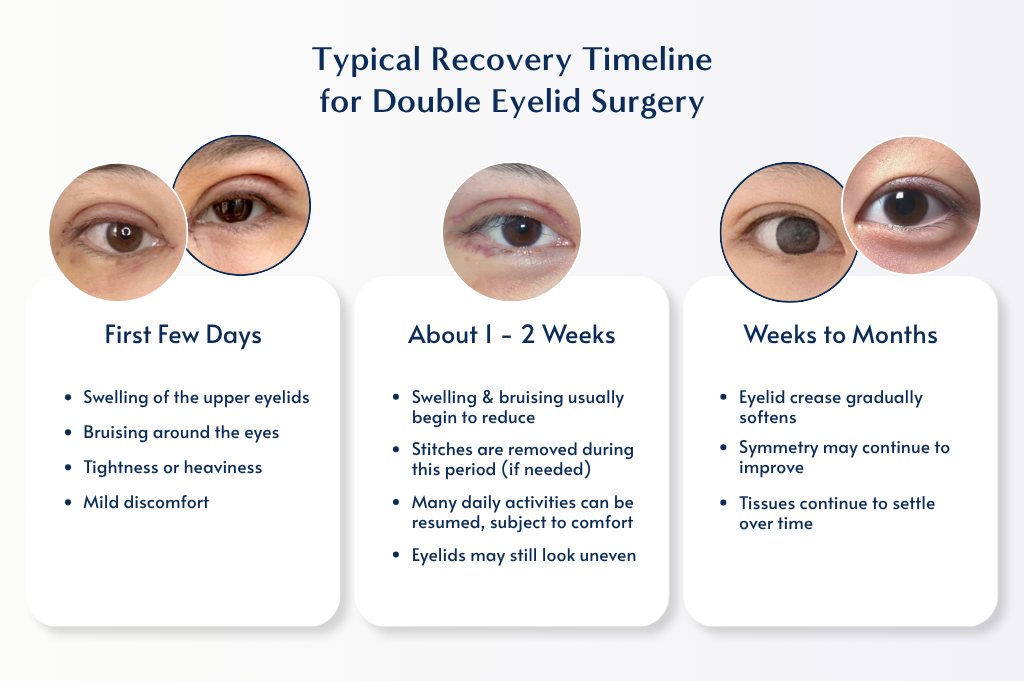
Early Phase: First Few Days
These changes occur because the eyelid tissues are thin and highly vascular. Even small surgical adjustments can trigger noticeable swelling. During this phase, the eyelids may appear uneven, and the crease may look higher or less defined than expected. In Singapore’s warm and humid climate, some patients also notice that swelling feels more pronounced later in the day, especially if they are active or outdoors.Short-Term Recovery: First 1–2 Weeks
Over the next one to two weeks, swelling and bruising usually begin to reduce gradually. Some patients feel comfortable returning to work within this window, while others prefer more time before resuming social or professional interactions.Intermediate Healing: Weeks to Months
After the initial recovery phase, healing continues in less visible ways. It is common for the eyelids to look slightly different from week to week during this stage. Temporary unevenness does not necessarily indicate a long-term issue, as tissues continue to adapt and stabilise.Longer-Term Healing
Scar maturation and tissue remodelling can continue for several months. Surgeons generally avoid assessing final results too early because:- Scar tissue takes time to soften
- Residual swelling may persist subtly
- Eyelid shape can continue to evolve
How Long Is the Downtime After Double Eyelid Surgery?
For some patients, downtime refers to when they feel comfortable returning to work or social settings. For others, it relates to when swelling becomes less noticeable. Factors that influence downtime include:- The surgical technique used
- Skin thickness and eyelid anatomy
- Individual healing response
- Nature of work (e.g. desk-based vs physically active roles)
Managing Swelling, Discomfort, and Tightness
During recovery, patients commonly describe sensations such as:- Tightness when opening the eyes
- Mild aching or pressure
- Dryness or temporary sensitivity
- Rest and sleep position: Head elevation may be suggested to help manage swelling
- Screen use: Prolonged screen time can contribute to dryness or fatigue early on
- Hygiene: Keeping the incision area clean is important during early healing
- Makeup and contact lenses: Timing for resumption is usually guided individually
Why Recovery Experiences Vary Between Patients
It can be tempting to compare recovery timelines with others, but this is often misleading. Differences in healing may relate to:- Eyelid anatomy and skin quality
- Tissue response to surgery
- Personal healing tendencies
- Environmental factors, including climate and daily activity levels
When to Check In With the Doctor During Recovery
Follow-up appointments allow healing to be monitored and questions to be addressed as recovery progresses. Patients are generally encouraged to seek review if they notice:- Increasing pain rather than gradual improvement
- Significant asymmetry that worsens over time
- Signs of infection or delayed healing