Around the world, eyelid surgery is one of the more commonly discussed cosmetic procedures, with more than two million performed. In many parts of Asia, interest in double eyelid surgery is especially noticeable, largely because eyelid structure varies from person to person and across populations.
Eyelid surgery in Singapore is often discussed in aesthetic enhancements, but from a clinical perspective, safety and limitations are usually central to any meaningful conversation. The eyelids are delicate structures that play a role not only in appearance but also in eye protection, lubrication, and comfort. Because of this, even small surgical changes can have effects beyond what is immediately visible.
This article focuses on helping you understand how eyelid surgery is assessed from a safety standpoint. It looks at common risks, situations where surgery may be avoided, and the kinds of concerns that are typically addressed during your consultation.
What Is Double Eyelid Surgery?
“Double eyelid surgery” is a general term used to describe procedures that create or define a visible crease in the upper eyelid. Some people naturally have this crease, while others have a smooth upper eyelid without a distinct fold when the eyes are open. It is estimated that half of the people of Asian descent do not have an upper eyelid crease.
From a technical standpoint, the procedure involves creating a connection between the eyelid skin and the underlying structures so that a crease forms when the eyelid moves. There are different surgical approaches, and the choice of method depends on factors such as eyelid thickness, skin elasticity, and existing eyelid anatomy.
Understanding what double eyelid surgery involves helps explain why safety can differ from person to person. The way a crease is created is not the same for everyone, and a method that works for one type of eyelid may not be suitable for another.
How Eyelid Anatomy Affects Surgical Risk
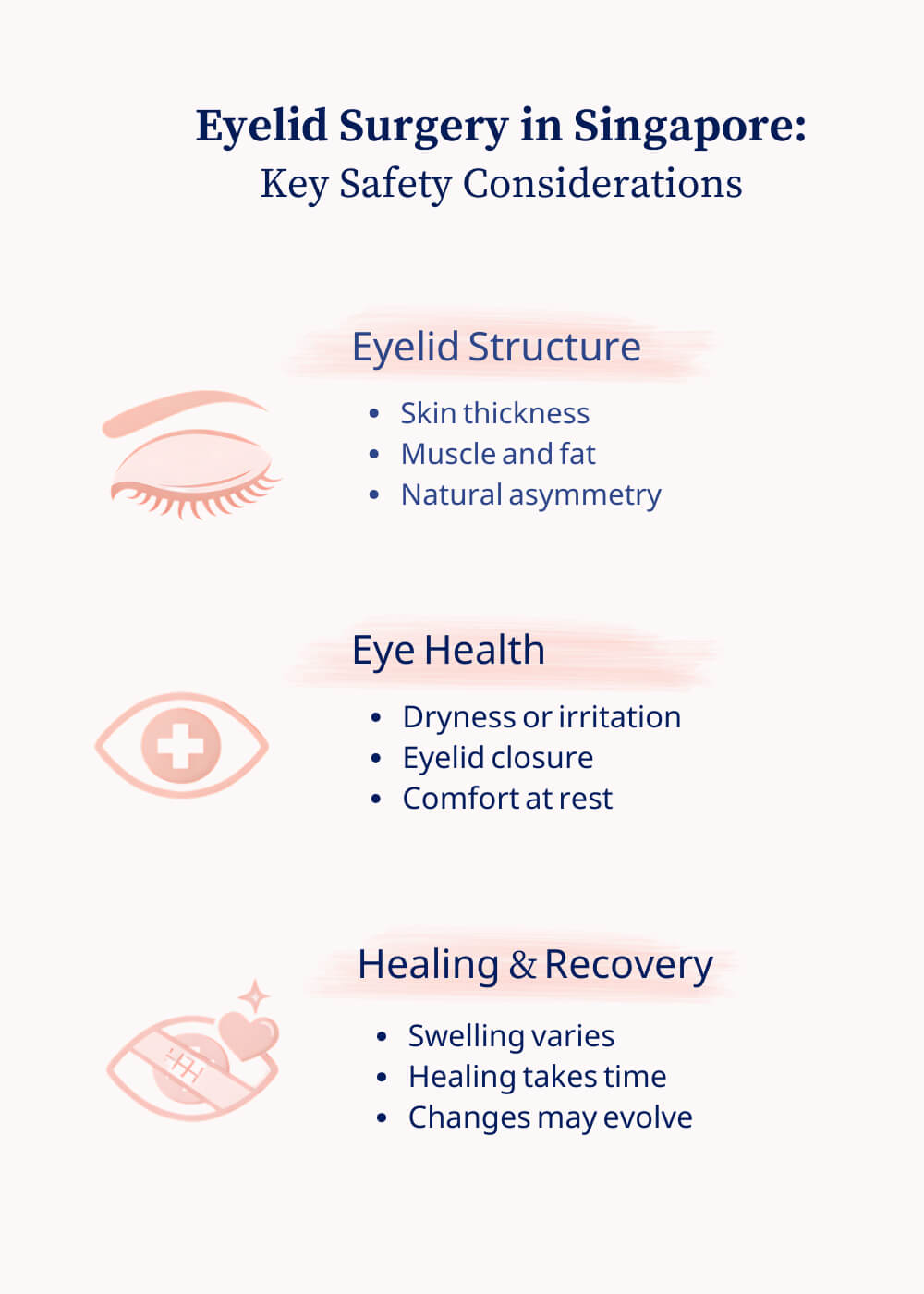
The upper eyelid is made up of several layers, including skin, muscle, connective tissue, and fat. These layers vary significantly from person to person. Some eyelids are thin and flexible, while others are thicker or have more fatty tissue.
Anatomy matters because it influences:
- How predictable a crease formation may be
- How the eyelid heals after surgery
- How visible scarring might be
- How the eyelid moves and closes after the procedure
For example, thicker eyelids may place more tension on sutures or incisions, while reduced skin elasticity can affect how well a crease holds over time. Natural asymmetry between the left and right eyelids is also common and may become more noticeable after surgery.
Educational diagrams of eyelid anatomy are sometimes used during consultations to help patients visualise these layers. However, keep in mind that these visuals are for anatomical understanding only and do not represent surgical outcomes.
Is Double Eyelid Surgery Safe?
Patients in Singapore often ask whether double eyelid surgery is “safe,” but in medical practice, safety is not a fixed yes-or-no answer. Instead, doctors usually look at the balance of possible risks for each individual, taking into account personal health, eye condition, and eyelid structure before discussing whether surgery may be appropriate.
Before discussing surgery, a doctor typically evaluates factors such as:
- General medical history
- Eye health, including dryness or irritation
- Ability to fully close the eyes
- Previous eyelid procedures or injuries
- Healing tendencies, such as scarring patterns
Safety considerations are specific to the individual. A procedure that may be reasonable for one person could carry higher risks for another, even if the surgical technique is similar.
Common Risks Associated With Eyelid Surgery
All surgical procedures involve some degree of risk, and eyelid surgery in Singapore is no exception. While many issues are temporary and resolve during healing, others may persist or require further management.
Commonly discussed risks include:
- Swelling and bruising
These are expected after surgery but may last longer in some individuals. - Asymmetry
Differences in crease height or shape between the two eyelids can occur, particularly in people with pre-existing asymmetry. - Scarring or crease irregularities
Scar visibility and crease definition can vary depending on healing and anatomy. - Changes in sensation
Temporary numbness or altered sensation may occur around the eyelids. In some cases, changes may persist. - Difficulty closing the eyes fully
This can affect eye comfort and dryness, especially in the early healing phase. - Dry eye symptoms
Surgery may temporarily worsen dryness or irritation, particularly in individuals with underlying dry eye conditions. - Infection or delayed healing
These are uncommon but possible with any surgical procedure.
Not every patient experiences these issues, and their severity varies. Understanding that risks exist — even when surgery is carefully planned — is part of informed decision-making.
When Eyelid Surgery May Be Avoided or Deferred
There are situations where eyelid surgery may not be recommended, or where postponement is advised.
Here are a few examples:
- Active eye surface conditions, such as significant dry eye or inflammation
- Medical conditions that affect wound healing
- Eyelid anatomy that limits predictable crease formation
- Unrealistic expectations about what surgery can change
In some cases, a doctor may suggest monitoring or non-surgical management instead of proceeding immediately.
Common Concerns Raised by Patients
When people ask about eyelid surgery in Singapore, their concerns often go beyond the crease itself. Many questions relate to how the eyelids will behave over time and whether changes will affect comfort, symmetry, or daily routines. These conversations are a key part of understanding whether surgery is suitable and what its limits may be.
Some of the common questions include:
- “Will my eyelids look uneven?”
Eyelids are naturally asymmetric in most people. Patients often want to know whether surgery can correct this or whether differences may still remain afterwards. - “What happens if the crease fades or changes?”
Crease definition can evolve as swelling settles and tissues heal. Patients may ask whether this is expected and how much change is considered within a normal range. - “Can the surgery be reversed or adjusted?”
This question often reflects concern about committing to a permanent change. Doctors usually explain which aspects may be adjustable and which changes are harder to reverse once healing has occurred. - “How long does healing usually take?”
Beyond visible swelling, patients may ask about stiffness, tightness, or subtle changes that can last longer than expected. - “What if I have had eyelid surgery before?”
Previous procedures can affect tissue quality and healing behaviour, which may change the risk profile of further surgery.
How Eyelid Surgery Risks Are Usually Mitigated
At Dream Aesthetics & Plastic Surgery, consultations are led by A/Prof Vincent Yeow, a board-certified plastic surgeon with over 20 years of experience in reconstructive and aesthetic surgery.
Consultations are focused on careful assessment, discussion of limitations, and helping individuals understand whether a procedure is appropriate for their specific anatomy and concerns.
While risks associated with eyelid surgery cannot be completely eliminated, they are typically addressed through a structured and cautious approach. This may include:
- Detailed pre-surgical assessment
- Conservative surgical planning
- Clear discussion of anatomical limits
- Step-by-step explanation of the healing process
- Post-procedure monitoring and follow-up
Patients play an important role as well, particularly by following aftercare instructions and reporting any concerns early. For individuals exploring eyelid surgery in Singapore, understanding what can vary, what cannot be guaranteed, and where risks may exist helps create a more realistic foundation for consultation.
To learn more about eyelid surgery and how it is assessed, schedule a consultation with us to discuss your questions in detail.