It is not uncommon for people to notice differences in eyelid shape, especially in a multi-ethnic and multicultural country like Singapore. Some have a visible crease that forms naturally when the eyes are open. Others may have a very faint fold or none, commonly known as monolids.
Those who prefer a visible eyelid crease to make their eyes look bigger and more defined may undergo a clinical assessment to understand what options may be considered based on their eyelid anatomy.
During a consultation with a doctor, the option of a double eyelid surgery may be discussed. It is a procedure used to create or define a fold in the upper eyelid.
There are two main approaches:
- Non-incisional techniques, sometimes called suture techniques
- Incisional techniques
Both are used to form a crease in the upper eyelid. The difference lies in how the eyelid tissues are accessed and adjusted to form a crease.
The choice is not just about personal preference. It depends on skin thickness, skin elasticity, fat content or whether there is excess skin.
Having a basic understanding of these two approaches can make it easier to follow the discussion during consultation.
What Is Double Eyelid Surgery?
To understand this procedure, it helps to first understand how a natural eyelid crease forms.
The crease appears when the skin of the upper eyelid is connected to the underlying muscle that lifts the eyelid, mainly the levator muscle and its connective tissue.
If this connection is well-defined, the skin folds inward when the eye opens, forming a crease. If the connection is less distinct, the eyelid may look smooth without a clear fold.
Double eyelid surgery focuses on creating that connection. By making changes to the skin, fat or muscle, a crease can form when the eye opens.
So while the procedure is often discussed in terms of appearance, what is actually being adjusted is how the skin, connective tissue and muscle interact within the eyelid.
Why Eyelid Creases Form Differently
Not all eyelids are structured the same way. That is why some people have a clear crease, while others don’t. There are a few key factors that affect this, particularly:
Skin Thickness
The skin on the upper eyelid can be thin or thick. Thicker skin tends to fold less easily, so a crease may not show clearly.
Eyelid Fat Distribution
There are small fat pads in the upper eyelid. When there is more volume in this area, it can make the eyelid look fuller and reduce how much the skin folds.
Muscle Attachments
The levator muscle lifts the eyelid, and the way its connective tissue attaches to the skin influences crease formation. If that connection is well defined, a crease forms as the eye opens. If it is not, the eyelid may remain smooth.
Skin Elasticity
Skin flexibility also affects how easily a crease can form. Skin that is more elastic tends to fold more readily. As the skin changes with age, it may not fold in the same way, which can affect how the crease appears.
These differences are the reason why the same technique is not suitable for every eyelid.
Types of Double Eyelid Surgery
The following sections outline the two main techniques performed by plastic surgeons.
- Non-incisional double eyelid surgery
- Incisional double eyelid surgery
Each technique creates the crease in a different way.
Non-Incisional Double Eyelid Surgery (Suture Technique)
This method is often called the suture technique.
What the Method Involves
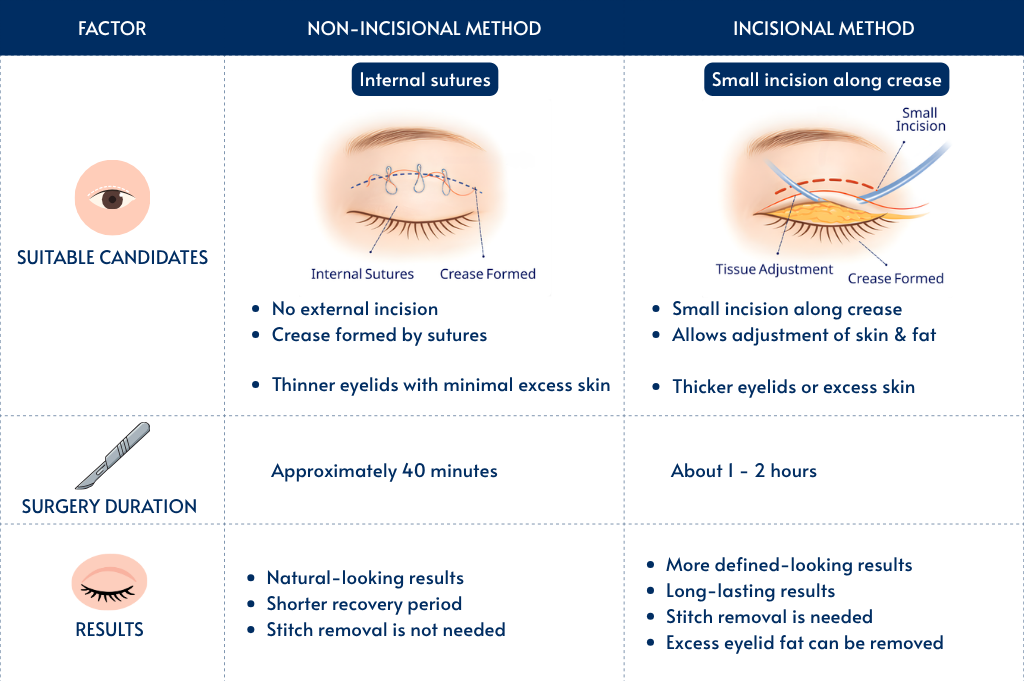
Small sutures are weaved and stitched beneath the skin of the upper eyelid. These sutures connect the skin to the deeper structures that lift the eyelid.
When the eye opens, that connection allows a crease to form.
There is no continuous cut along the eyelid crease in this approach.
When this Method May be Considered
This technique tends to be considered when the eyelid structure has characteristics like:
- Thinner eyelid skin
- Little to no excess skin
- Smaller fat volume in the upper eyelid
In these situations, this technique may be suitable to achieve the double eyelid result.
What Characterises this Technique
- The crease is formed using internal sutures
- Deeper tissues are not extensively adjusted
- There is no visible incision line along the crease
Considerations
Because the crease depends on sutures, how it holds can vary.
If there is more weight in the eyelid or tension in the tissues, the crease may become less defined over time. This is why the decision to use this method comes back to how the eyelid is structured, rather than preference alone.
Incisional Double Eyelid Surgery
This is another technique used to create a double eyelid crease. It generally provides a more defined and longer lasting crease. This approach typically involves a longer recovery period and care of the incision area is required during healing.
What the Method Involves
A small cut is made along the planned crease line. This allows the surgeon to directly access and adjust the underlying eyelid structures, including the skin, fat and connective tissues.
Once the necessary adjustments are made, the skin is closed in a way that forms a crease when the eye opens.
When this Method May be Considered
This approach is considered when the eyelid has more structure to manage, for example:
- Thicker skin
- Excess upper eyelid skin
- More fat in the eyelid
In these situations, sutures alone are usually not enough to create a stable crease.
What Characterises this Technique
- A small incision is made along the crease line
- The surgeon can directly adjust skin and fat and/ or muscle
- The crease is formed through structural changes in the eyelid
Points to Understand
Because this method involves an incision, healing takes a different course compared to the suture technique. How the eyelid settles depends on factors like skin quality, tissue thickness and how the body heals.
Comparing Incisional and Non-Incisional Techniques
Both methods are used to create an eyelid crease, but they work in different ways.
The non-incisional technique relies on sutures placed beneath the skin to form a connection that creates the fold. The incisional technique involves making a small cut along the crease, which allows direct adjustment of the skin, fat and connective tissue before forming the crease.
How Surgeons Assess Which Method May Be Appropriate
When you come in for a consultation to discuss double eyelid surgery, the first step is a careful assessment of your eyelid.
Specifically, the doctor will examine your eyelid structure and how it moves when you open and close your eyes, to determine which approach may be suitable.
Some of the things that are usually assessed include:
- How thick the eyelid skin is
- Whether there is excess skin
- The amount and position of fat in the eyelid
- Whether there is a natural crease, even if it is faint
- The overall eye shape and symmetry
These details guide the discussion. They help determine whether a suture approach may be enough, or whether an incisional method needs to be considered.
Since eyelids vary quite a bit from person to person, the same technique will not work the same way for everyone.
Understanding Limitations and Variability
Eyelid surgery outcomes can vary due to differences in tissue characteristics and healing patterns.
A few factors that tend to affect this include:
- Eyelid anatomy
- Skin thickness and elasticity
- How the tissues respond during healing
Because of these factors, the crease may not look exactly the same from one person to another.
In practice, the discussion is usually centered on what your eyelid can support, rather than aiming for a fixed crease shape or height.
Common Questions People Ask About Double Eyelid Surgery
People exploring information about double eyelid surgery in Singapore often have practical questions about how the procedure works and how the different techniques compare. Here are some of the topics commonly discussed during consultations.
Does double eyelid surgery always involve an incision?
No. Double eyelid surgery may be performed using either an incisional technique or a non-incisional (suture) technique.
The non-incisional method creates the crease using sutures placed beneath the eyelid skin, without a continuous external incision along the crease.
The incisional method, on the other hand, involves a small incision along the planned crease, which allows the surgeon to directly adjust eyelid tissues.
Which technique may be considered depends largely on how the eyelid is structured.
How do doctors decide which technique to use?
It comes down to the eyelid itself. During assessment, the doctor looks at:
- Skin thickness
- Whether there is excess skin
- Fat volume in the eyelid
- Whether there is an existing crease
- Eye shape and symmetry
If the eyelid has minimal excess tissue, sutures may be enough. If there is more thickness or excess skin, an incisional approach is usually considered.
Can the eyelid crease change over time?
Yes, it can. With suture techniques, the crease depends on how the sutures hold within the tissue, and this connection may loosen over time.
With incisional techniques, the crease is formed through structural attachment. However, changes can still occur as the skin and tissues age.
Factors such as ageing, natural tissue changes, and lifestyle habits may influence how the crease changes over time.
Are the results the same for everyone?
No. Eyelids vary in skin thickness, fat volume, and how the tissues respond. These differences affect how the crease forms. Because of that, the crease height, shape, and definition will not be identical across different people. The discussion usually focuses on what can be achieved based on your eyelid anatomy.
Considering Double Eyelid Surgery?
Double eyelid surgery generally falls into two main techniques/categories: non-incisional (suture) techniques and incisional techniques. Both approaches aim to create an upper eyelid crease, but they differ in how the crease is formed and how the eyelid structures are addressed.
Understanding the differences between these methods can help clarify discussions about the types of double eyelid surgery techniques that may be considered. Because eyelid anatomy varies from person to person, the choice of surgical method is typically determined after a careful assessment of the eyelid structure.
At Dream Aesthetics & Plastic Surgery, consultations are conducted by A/Prof Vincent Yeow, a board-certified plastic surgeon with over 20 years of experience in reconstructive and aesthetic surgery. Those who wish to better understand how eyelid anatomy is assessed and how different double eyelid surgery techniques are discussed may schedule a consultation for a personalised evaluation.