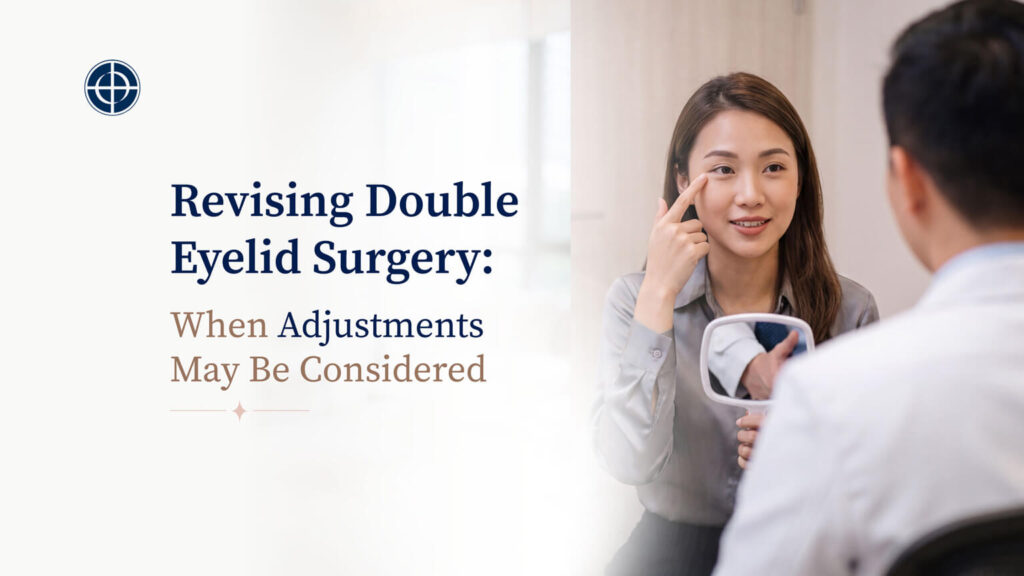
For patients who may be thinking of undergoing double eyelid surgery in Singapore, one of the questions they might have is “What if something unexpected happens or I don’t like the result?” “Can I have it undone? Can it be corrected?
It is a common concern. After all, double eyelid surgery involves changing the appearance of the upper eyelid and the idea of creating a more lasting eyelid crease can make some patients hesitant.
Whether a double eyelid can be revised, lowered or otherwise adjusted depends on several factors, including the surgical technique used, the condition of the eyelid tissues and the timing of the previous surgery. In some cases, an existing crease can be modified. In others, returning the eyelid completely to how it looked before surgery may not be possible.
Why Patients May Consider Revising Double Eyelid Surgery
There are different reasons why someone may seek a revision.
A patient may feel that the crease is higher than expected or that the eyelids look different from what was expected before surgery. Another may notice asymmetry between the two eyes. Sometimes, the concern only becomes apparent after the swelling has settled and the eyelids have had time to heal.
The appearance of the eyelids can also change over time because the eyelid tissues continue to age. Skin may lose elasticity, soft tissue position may change, and a crease that once looked appropriate may later appear different.
However, these situations do not necessarily mean that the surgery has failed or that a complication has occurred. It is important to remember that as the natural ageing process occurs, so do the eyelids after surgery.
For this reason, revision surgery is generally considered only after the doctor has assessed the eyelids and allowed sufficient time for the tissues to heal.
Can Double Eyelid Surgery Be Undone?
When patients search for “reversing double eyelid surgery,” they may imagine that the eyelid can be returned to its previous state. That is not necessarily the case, particularly after an incisional procedure where tissue has been altered or removed.
In some cases, the crease can be adjusted or lowered. However, the extent to which this can be done depends largely on the original procedure and the condition of the tissues.
It is sometimes possible to adjust an existing crease, but it is not always possible to restore the eyelid exactly to its original state. Changes to the tissues and scar formation may remain after surgery.
A revision procedure may instead focus on improving the position or appearance of the existing crease rather than completely erasing every change made during the first surgery.
The Surgical Technique Makes a Difference
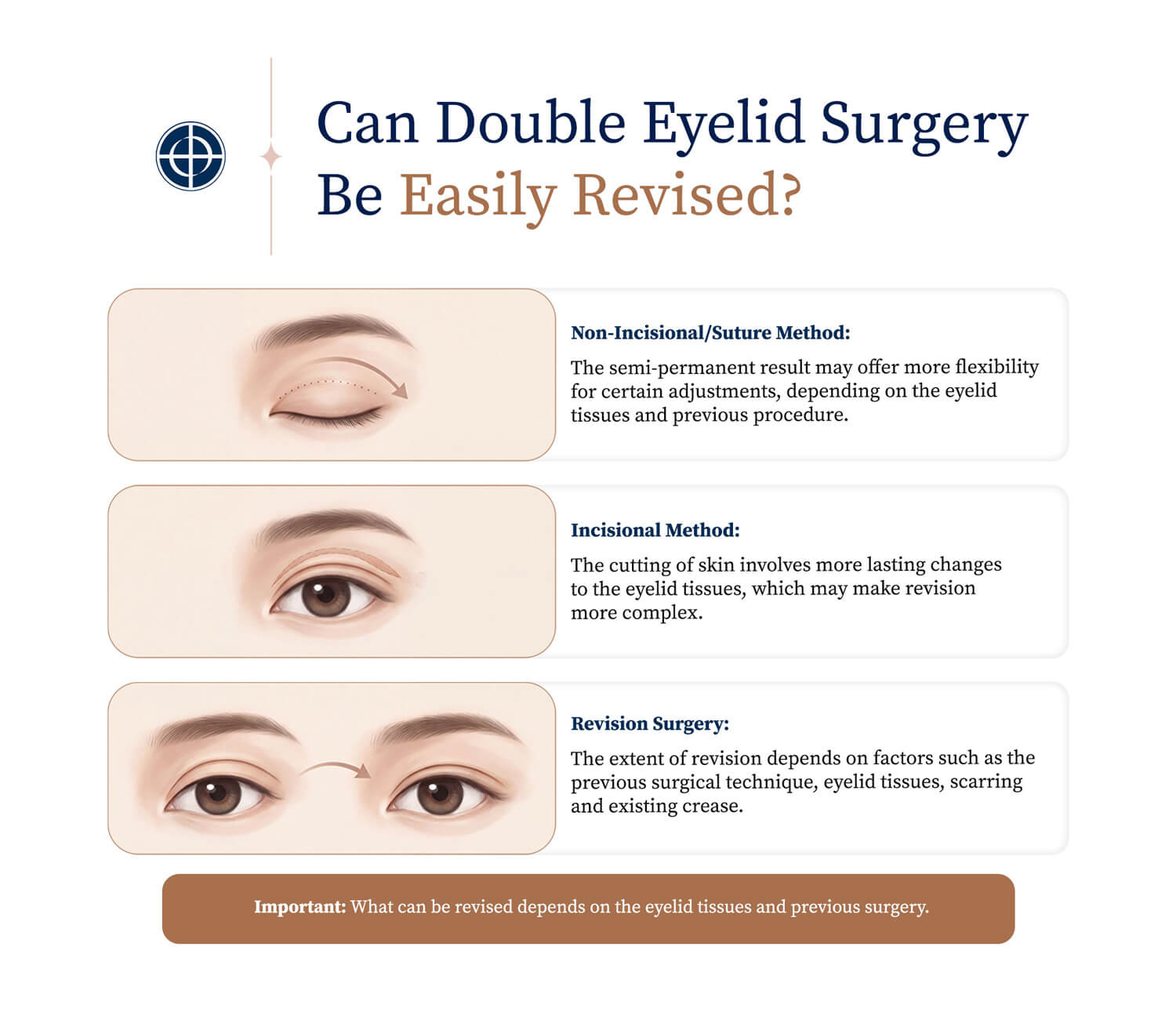
There are generally two broad approaches to double eyelid surgery: non-incisional and incisional techniques.
With a non-incisional or suture method, sutures are used to create the eyelid crease without making a longer incision along the eyelid. Because the tissues have not been altered in the same way as with an incisional procedure, there may be more flexibility when adjustments are considered.
However, this does not mean that a suture-created crease can always be removed without any lasting change.
A non-incisional approach may last for years in some patients, but the crease can loosen over time. An incisional approach usually creates a more lasting structural change because the tissues are altered more directly.
With an incisional procedure, the surgeon makes an incision and may remove or reposition tissue as part of creating the crease. Once tissue has been removed or scar tissue has formed, simply “undoing” the procedure becomes considerably more complicated.
This is why the choice of surgical technique should be discussed carefully before surgery rather than assuming that a revision will always be possible later.
What Happens During Revision Surgery?
There is no single revision procedure that applies to every patient.
During the consultation, the doctor first needs to understand what has changed and what the patient hopes to address. This may involve looking at the height of the crease, the symmetry of both eyelids, the amount of skin present and the condition of the underlying tissues.
In some cases, the issue may be an overly high crease. In others, there may be asymmetry or an unnatural contour. As a result, revision surgery can be more complex because the normal anatomy has already been altered and scar tissue may be present. This reduces the flexibility of the tissues such that planning needs to be more careful.
The aim is therefore not simply to “redo” the original procedure. The doctor has to work with the eyelid as it is at the time of revision.
Why Scar Tissue Matters
Scar formation is a normal part of healing after surgery. However, scar tissue can affect the way the eyelid moves and how easily the tissues can be adjusted during a second procedure.
This is one of the reasons why revision surgery can be more technically demanding than the first operation.
The condition of the eyelid tissues also matters. Skin thickness, fat distribution and muscle strength can influence how the eyelid settles after surgery. Swelling and the body’s healing response can also affect the appearance during recovery.
When Should a Revision Be Considered?
It is not advisable to judge the final appearance of the eyelids soon after surgery. Swelling, bruising and tightness can temporarily make the crease appear higher or the two sides look uneven.
It is important to remember that healing from a double eyelid surgery is gradual and that the eyelids can continue to change as swelling subsides and the tissues settle. Most swelling and bruising usually improve within one to two weeks after double eyelid surgery, although the eyelids may continue to settle over the following weeks to months.
For this reason, patients are generally advised to allow adequate time for healing before making decisions about further surgery. The appropriate timing depends on the procedure, the healing process and the concern being assessed.
However, if there is a significant or unexpected problem during recovery, such as increased swelling, persistent bleeding, severe pain and signs of infection, patients should contact their doctor rather than waiting for the issue to resolve on its own.
Can Revision Restore Symmetry of Eyelids?
Natural faces are rarely symmetrical. There may already be differences between the two eyelids before surgery, and these differences can remain after treatment.
The aim of double eyelid surgery, therefore, is balance rather than exact symmetry. The degree of improvement depends on the patient’s anatomy and what can reasonably be achieved.
This is particularly relevant when considering revision because the tissues have already undergone surgery. Trying to make both eyelids exactly identical may not always be realistic or appropriate.
What Should You Ask Before Considering Revision?
If you are considering revision surgery, it may be helpful to discuss several questions during consultation.
You can ask what is causing the current concern, whether the eyelids have fully healed and what changes may be possible. It is also reasonable to ask whether the original technique affects the options available for revision and what limitations may remain because of scar tissue or previous tissue changes.
If the original surgery was performed elsewhere, bringing information about the previous procedure can also be useful. Knowing whether an incisional or non-incisional technique was used may help the doctor understand what changes have already been made.
Can You Undo Double Eyelid Surgery?
In some cases, an existing crease can be adjusted or lowered. However, revision should not be viewed as a guaranteed way of returning the eyelids exactly to their pre-surgery appearance.
The original surgical technique, tissue changes, scar formation, healing and the patient’s current eyelid anatomy all influence what may be possible. Revision surgery can also be more complex than the initial procedure because the normal anatomy has already been altered.
This is why concerns about permanence should be discussed before the first procedure. Understanding what the surgery involves, how the chosen technique works and what may or may not be possible in the future can help patients make a more informed decision.
At Dream Aesthetics & Plastic Surgery, consultations are conducted by Vincent Yeow, a board-certified plastic surgeon with more than 20 years of experience in reconstructive and aesthetic surgery. A consultation can be arranged if you would like to learn more.