It is understandable to feel concerned if your eyelids do not look the way you expected after surgery.
After double eyelid surgery, one crease may look different from the other, the crease may appear higher than expected, or the eyelids may seem uneven. If the surgery was done recently, some of these differences may change as swelling settles and the tissues heal. In other cases, they may remain after recovery.
If you are unhappy with how the eyelids look after surgery, the next step is usually not to rush into another procedure. The appearance of the eyelids can continue to change during recovery, so assessment at the appropriate stage can help determine whether the concern is part of healing or something that may need further attention.
This is particularly important when considering revision double eyelid surgery. Revision may be possible, but it can be more complex than the original surgery because the eyelid tissues have already been altered.
Early Differences Do Not Always Reflect the Final Result
There are two things to keep in mind during the early stages of recovery.
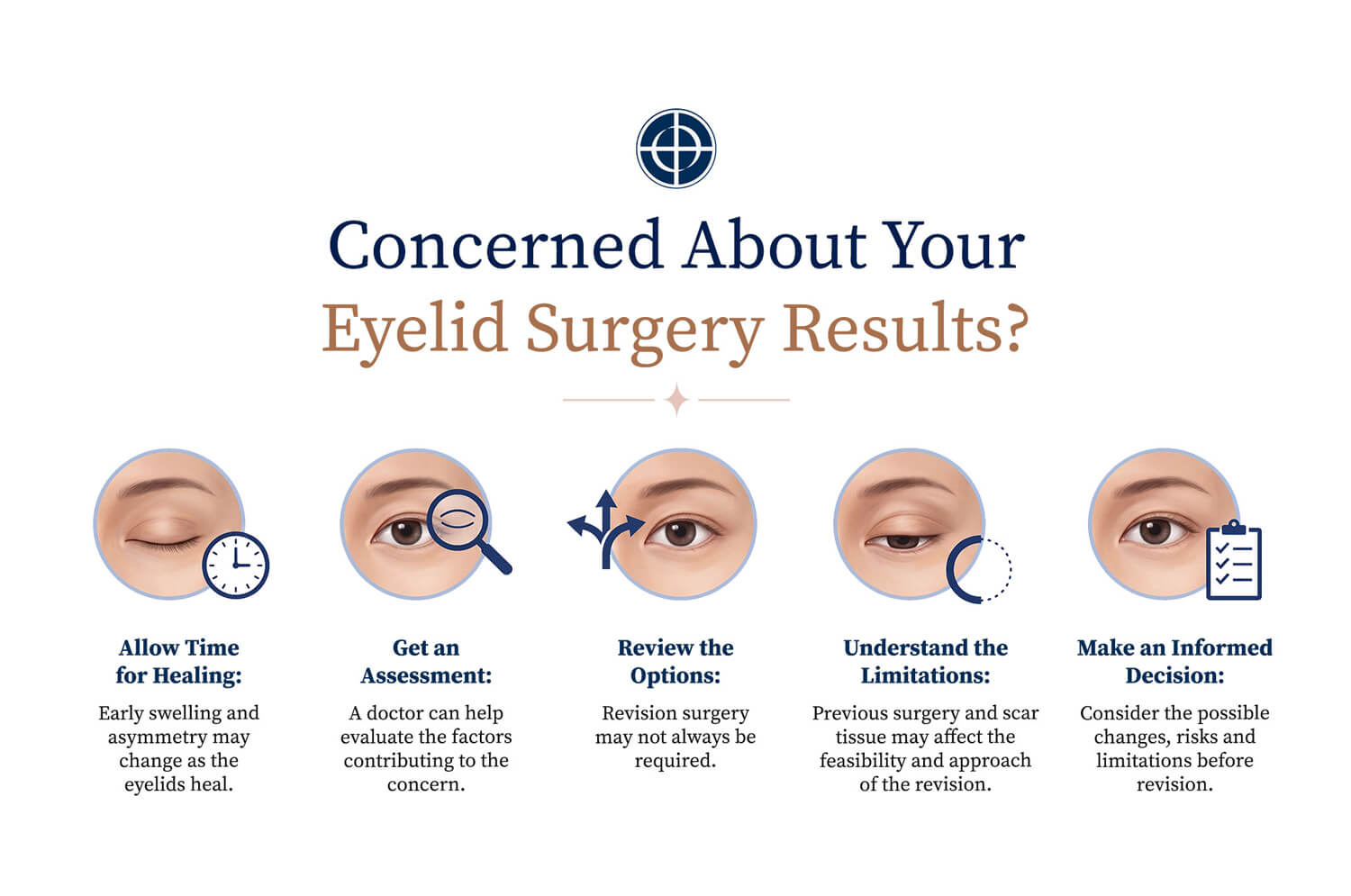
First, the appearance of the eyelids soon after surgery is not necessarily the final result. Swelling and bruising can be noticeable, and one eye may appear more swollen than the other. The crease may also look higher or less defined than expected.
Second, both eyelids may not heal at exactly the same pace.
As swelling settles, the appearance of the eyelids can change from week to week. Scar tissue also continues to change as healing progresses, and the tissues may take several weeks or months to settle. For this reason, it may be too early to assess the outcome immediately after surgery.
If you are concerned about your recovery, your doctor can assess how the eyelids are healing and whether further evaluation is needed.
What If You Still Do Not Like the Result After Healing?
Some concerns may remain after the initial healing period. These could include asymmetry, an overly high crease or an altered contour.
There can be several reasons for these differences. Some asymmetry may have been present before surgery, the tissues may have healed differently on each side, or the crease may have settled in a position that differs from what was expected.
It is also important to recognise that natural faces are not perfectly symmetrical and the aim is general balance rather than making both eyelids exactly identical.
Natural asymmetry does not necessarily explain every concern post-surgery. The doctor first needs to assess what is contributing to the difference before discussing whether any adjustment may be appropriate.
Start With an Assessment, Not Another Procedure
If you are unhappy with your eyelid surgery results, an assessment by your surgeon can help clarify what is contributing to the concern.
During the consultation, the doctor may assess the current condition of the eyelids, the amount and distribution of skin and fat, eyelid movement and the condition of the tissues. Previous surgical records may also be useful, especially if the procedure was performed elsewhere.
Skin thickness, fat distribution and muscle strength can all affect how the eyelid settles. Swelling, healing and scar formation can also influence its appearance over time.
The assessment may show that the next step is different from what the patient initially expected. In some cases, further surgery may not be needed. In others, an adjustment may be considered after the tissues have had enough time to heal.
When Can Revision Double Eyelid Surgery Be Considered?
Revision surgery may be considered when a concern remains after healing and there is something that may be possible to adjust. However, there is no single revision technique that applies to every patient.
The previous technique done can affect what may be possible with a revision surgery. A non-incisional technique creates the crease using sutures, while an incisional procedure involves an incision and changes the eyelid tissues more directly.
Factors such as skin thickness, fat distribution and muscle strength may also affect how the eyelid has healed and what options can be discussed.
Revision planning therefore usually involves understanding what was done previously and assessing the current condition of the eyelid.
When Should You Speak to Your Doctor?
If you are concerned about how your eyelids are healing, your doctor can assess whether the changes are expected during recovery or need further attention.
Follow-up appointments allow the doctor to monitor healing and address concerns as they arise. Earlier review may be appropriate if there is increasing pain, signs of infection, unexpected changes in the eyelid or concerns about delayed healing.
An assessment can also help determine whether what you are seeing is part of the normal healing process or something that may need further evaluation.
What Can You Do Before Considering Revision?
Before making a decision, it can be helpful to observe how your eyelids change over time rather than judging the result based on how they look on a particular day.
Follow the post-operative instructions provided by your doctor and attend scheduled follow-up appointments so healing can be assessed. Avoid comparing your recovery too closely with photographs or videos of other patients, as healing varies depending on the surgical technique, tissue characteristics and the body’s healing response.
If your surgery was performed by another doctor, bring any information you have about the original procedure to the consultation. Knowing which technique was used and what changes were made may help the assessing doctor understand what options, if any, may be appropriate.
Before Deciding on Revision
It can be concerning when the eyelids do not look the way you expected after surgery. However, their appearance during recovery may continue to change as swelling settles and the tissues heal.
Swelling, scar formation and differences in healing can all affect how the eyelids look in the weeks and months after surgery.
For some patients, revision double eyelid surgery may eventually be considered. However, revision can be more complex because the eyelid anatomy has already been altered and scar tissue may be present. What may be possible depends on the condition of the tissues and the concern being assessed.
For this reason, the eyelids usually need to be assessed before any decision about revision is made. This can help clarify whether the concern is still related to healing or whether further treatment may need to be discussed.
At Dream Aesthetics & Plastic Surgery, consultations are conducted by Vincent Yeow, a board-certified plastic surgeon with more than 20 years of experience in reconstructive and aesthetic surgery. A consultation can be arranged if you would like to learn more.