
Can Eyelid Surgery Improve Vision? Understanding the Difference Between Cosmetic and Functional Eyelid Procedures
One of the more common questions raised during a consultation is whether eyelid surgery can improve vision. The answer depends on what is causing the eyelid concern, because not every eyelid procedure serves the same purpose.
Three terms often come up in this conversation: double eyelid surgery, blepharoplasty and ptosis repair. Although they all involve the eyelids, they do not mean the same thing.
Double eyelid surgery is an upper eyelid procedure focused mainly on creating or defining an eyelid crease. It may be performed using a non-incisional suture technique or an incisional technique.
Blepharoplasty is a broader term for surgery involving the eyelid tissues and may be performed on the upper eyelids, lower eyelids or both.
Ptosis repair is different. It addresses an upper eyelid that sits lower than normal because of an issue affecting the structures responsible for lifting the eyelid. Depending on the cause, different surgical techniques may be used to improve the eyelid position.
So, when can eyelid surgery affect vision and when is it mainly about appearance? The first step is understanding what is causing the eyelid to look or feel different.
Signs That May Point to More Than a Crease Concern
Patients may describe their eyes as looking smaller or heavier than before. Some notice that one eyelid sits lower than the other, while others find themselves raising their eyebrows throughout the day without realising it.
Raising the eyebrows engages the frontalis muscle in the forehead. In some patients with ptosis, this may be a way of compensating for a low upper eyelid and helping to keep the eye more open.
However, eyebrow elevation alone does not confirm ptosis. Excess upper eyelid skin, brow position and habitual facial movement may also contribute.
This is why the appearance of a heavy eyelid cannot reliably tell us whether the concern comes from the eyelid crease, excess skin, the eyelid-lifting mechanism or a combination of these factors.
Can Double Eyelid Surgery Fix Ptosis?
Not on its own.
Double eyelid surgery focuses mainly on creating or refining an upper eyelid crease. Depending on the technique and the patient’s anatomy, it may also involve adjustment of selected skin or fat.
Ptosis repair addresses a different problem. Ptosis occurs when the upper eyelid margin sits lower than normal because of an issue affecting the eyelid-lifting mechanism.
In many patients, treatment involves adjustment of the levator muscle or its tendon-like attachment, known as the levator aponeurosis. Other approaches may be considered depending on the type and severity of the ptosis.
If clinically prominent ptosis is present, crease creation alone does not correct the underlying eyelid-lifting problem. The low eyelid position may therefore remain, and an existing difference between the two eyes may continue to be noticeable.
This is one reason why the eyelid position and lifting function should be assessed before deciding whether the concern is mainly about the crease or whether ptosis is also present.
Droopy Eyelid: Is It the Skin or the Eyelid-Lifting Mechanism?
A heavy or drooping-looking upper eyelid does not always mean that the eyelid-lifting mechanism is weak.
Excess upper eyelid skin, known as dermatochalasis, may fold over the natural eyelid crease or extend towards the eyelashes. This can make the upper eyelid appear heavy even when the eyelid-lifting mechanism itself is functioning normally.
Ptosis is different. In ptosis, the upper eyelid margin itself sits lower than expected.
The two conditions can also occur together.
Where excess skin is the main concern, upper blepharoplasty may be used to remove or adjust the redundant skin. Where ptosis is present, treatment needs to address the structures responsible for lifting the eyelid.
Some patients may therefore require treatment of the excess skin, the ptosis or both, depending on the clinical findings.
When Can Eyelid Surgery Affect Vision?
Eyelid surgery may affect the visual field when eyelid tissue physically obstructs part of what a person can see.
One example is pronounced ptosis. If the upper eyelid margin sits low enough to interfere with the pupil or upper visual field, ptosis repair may improve the obstruction by raising the eyelid position.
Another example is upper eyelid dermatochalasis. Excess skin may hang over the eyelashes and obstruct part of the upper or peripheral visual field. In suitable patients, removing the excess skin through upper blepharoplasty may improve the obstructed visual field.
This is different from double eyelid surgery performed mainly to create or refine an eyelid crease.
Double eyelid surgery does not, on its own, improve eyesight or visual acuity.
Whether an eyelid concern is functional or mainly aesthetic depends on the underlying cause, its severity and whether it interferes with daily activities. This requires a clinical assessment rather than judging the eyelid from appearance alone.
Does Eyelid Surgery Put Vision at Risk?
It is understandable for patients to be concerned about surgery performed close to the eyes.
Temporary blurred vision, dryness, watering, irritation, swelling or discomfort may occur during the recovery period following eyelid surgery.
Serious complications affecting the eye or vision are uncommon but are recognised risks of eyelid surgery. The risks vary depending on the procedure and the patient’s anatomy and should be discussed before treatment.
It is also important to distinguish between visual acuity and visual field.
Eyelid surgery does not correct refractive problems or make someone see more clearly in the way that glasses, contact lenses or eye surgery might.
In selected patients with significant ptosis or excess upper eyelid skin, treatment may instead improve an area of the visual field that was being physically obstructed by the eyelid.
What Happens During a Consultation?
An eyelid consultation usually involves more than looking at whether the eyelids appear symmetrical.
The doctor may assess:
- The position of the upper eyelid margin
- Upper eyelid lifting function
- Eyelid crease position and shape
- The amount and distribution of upper eyelid skin
- Fat distribution
- Brow position
- Differences between the two eyes
- Eyelid closure and overall eyelid function
Where ptosis is suspected, the movement of the upper eyelid may be measured to assess how well the eyelid-lifting mechanism is functioning.
If ptosis or excess upper eyelid skin may be affecting the visual field, a visual field assessment may also be considered. This helps determine whether part of the field of vision is being obstructed.
These findings are considered together before deciding whether the concern is mainly related to the eyelid crease, excess skin, ptosis or more than one factor.
What to Ask During a Consultation
If you are uncertain about what is causing an eyelid concern, questions you may want to ask include:
- What is causing my eyelid to look or feel this way?
- Is the concern mainly related to excess skin, the eyelid crease or the eyelid-lifting mechanism?
- Do I have ptosis?
- Is treatment medically necessary or mainly an aesthetic choice?
- If my visual field is affected, what is causing the obstruction?
- What would the proposed procedure involve?
- Will the procedure address the underlying cause of my concern?
- What are the possible risks and limitations?
What to Expect During Recovery
Recovery varies depending on the procedure performed, the amount of tissue involved and the individual patient’s healing response.
During the early recovery period, patients may experience:
- Swelling
- Bruising
- Tightness around the eyelids
- Temporary asymmetry caused by swelling
- Dryness or watering
- Temporary changes in sensation
The eyelid crease or eyelid position may initially appear higher, firmer or less symmetrical before gradually changing as swelling reduces and the tissues heal.
Non-incisional double eyelid procedures may have a shorter initial recovery period than incisional procedures because there is no full skin incision.
Incisional double eyelid surgery, upper blepharoplasty and ptosis repair may take longer to settle. Swelling and bruising generally improve progressively, while the eyelid contour, crease and scars may continue to change over several weeks or longer.
Following ptosis repair, review appointments may also include assessment of eyelid height, symmetry, eyelid closure and lifting function.
Individual recovery varies, so the expected recovery period should be discussed according to the procedure being considered.
Different Eyelid Concerns, Different Procedures
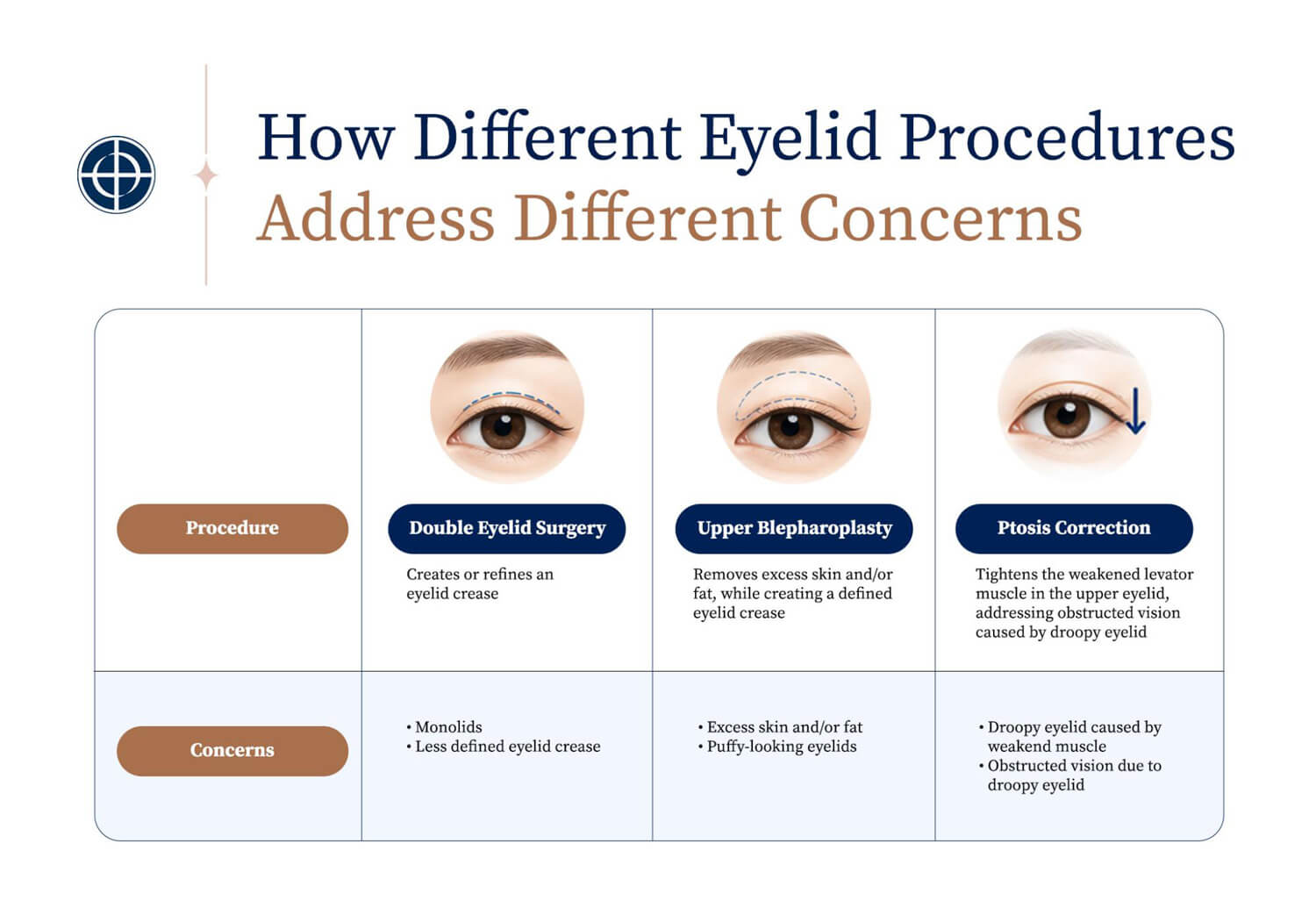
Double eyelid surgery, blepharoplasty and ptosis repair address different aspects of the eyelid.
Double eyelid surgery is mainly concerned with creating or refining an upper eyelid crease.
Upper blepharoplasty may address excess skin, fat and other upper eyelid tissue concerns and may also include crease adjustment where appropriate.
Ptosis repair addresses an upper eyelid that sits lower than normal because of a problem affecting its lifting mechanism.
Neither double eyelid surgery nor eyelid surgery in general improves visual acuity. However, in selected patients with ptosis or excess upper eyelid skin, treatment may improve an obstructed visual field.
Understanding the underlying cause matters more than choosing a procedure based on its name. An eyelid assessment through a consultation can help determine whether the concern relates mainly to crease formation, excess tissue, ptosis or a combination of these factors.
At Dream Aesthetics & Plastic Surgery, consultations are conducted by Vincent Yeow, a board-certified plastic surgeon with more than 20 years of experience in reconstructive and aesthetic surgery. A consultation can be arranged if you would like to learn more.